
 New
Programmers
AT24 / FM24 I2C EEPROM
Part no.GH₵29.00
Never lose your critical project data during a power cycle again. The AT24 / FM24 I2C Memory Module provides a reliable, non-volatile storage solution for your microcontrollers and embedded systems. Whether you need to log telemetry data from your sensor arrays, store calibration settings, or save the operational state of an ESP32, Arduino Uno, or STM32 project, this compact board delivers seamles
Only 1 leftShips from Accra · Fast delivery across all 16 regions of Ghana and beyond!
- Same-day dispatch in Accra for orders before 14:00
- Pay securely with Mobile Money or card
- Genuine parts, tested before dispatch
Overview
AT24 / FM24 I2C EEPROM / FRAM Memory Expansion Module
Product Overview
Never lose your critical project data during a power cycle again. The AT24 / FM24 I2C Memory Module provides a reliable, non-volatile storage solution for your microcontrollers and embedded systems. Whether you need to log telemetry data from your sensor arrays, store calibration settings, or save the operational state of an ESP32, Arduino Uno, or STM32 project, this compact board delivers seamless data retention.
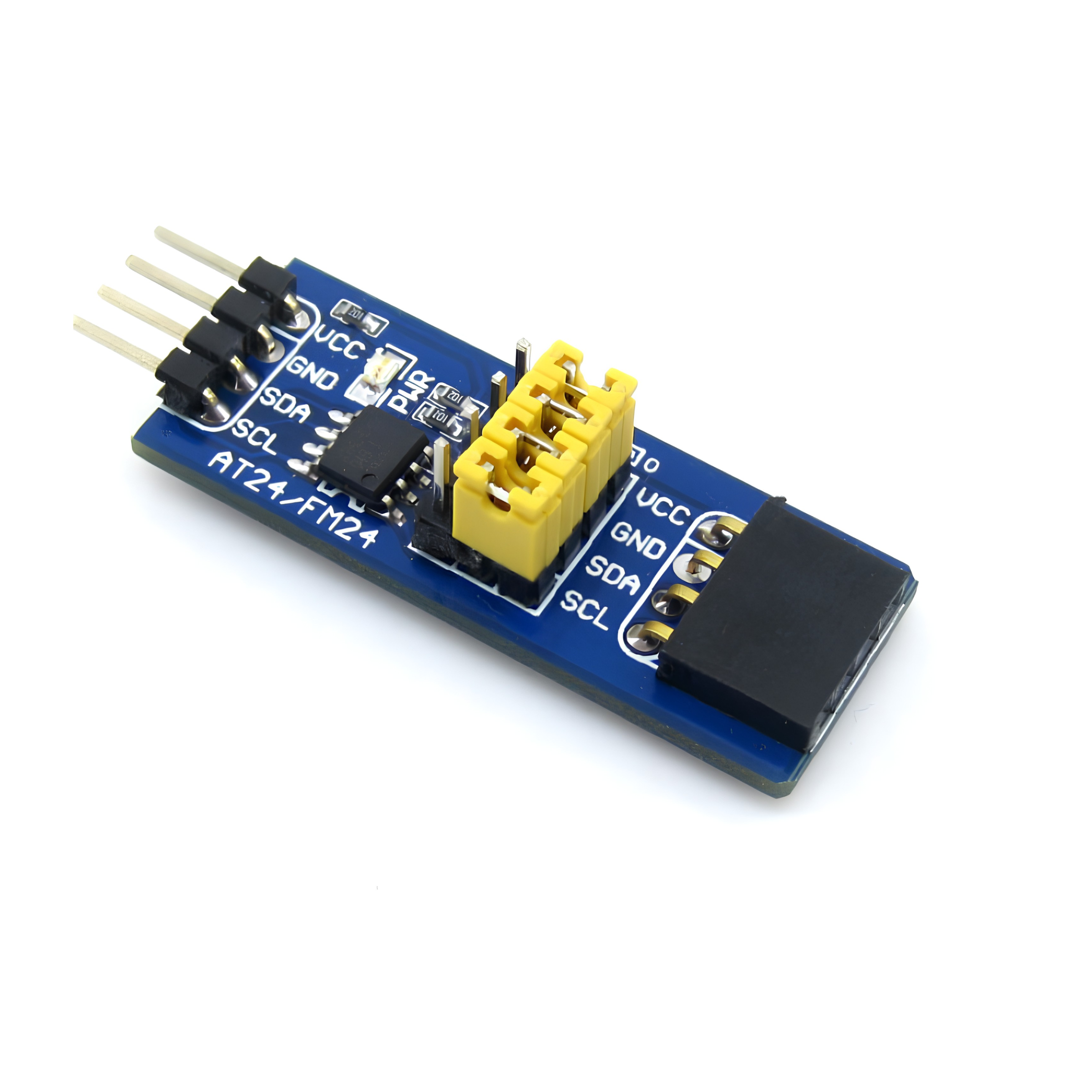
Operating over the standard I2C (Two-Wire) interface, it requires only two data pins (SDA and SCL) to communicate, saving valuable I/O on your development boards. Built for flexibility, the module features a clever pass-through pin design, allowing you to easily cascade multiple modules or I2C devices on the same bus, making it an essential building block for any hardware prototype.
Key Features
-
Non-Volatile Storage: Retains written data safely without the need for a backup battery. (Supports standard AT24 series EEPROM or high-endurance FM24 series FRAM chips).
-
Daisy-Chainable Design: Features male header pins on one end and a female header socket on the other. This allows you to stack or plug multiple I2C devices in a row without needing a breadboard or messy wiring hubs.
-
Configurable I2C Address: Equipped with onboard yellow hardware jumpers. These allow you to easily modify the device's hardware address (typically A0, A1, A2 pins on the chip), ensuring no address conflicts when running multiple memory modules on the same bus.
-
Universal I2C Interface: Uses the standard SDA (Data) and SCL (Clock) lines, ensuring plug-and-play compatibility with virtually every modern microcontroller and single-board computer.
-
Status Indicator: Includes a built-in "PWR" LED for instant visual confirmation that the module is receiving voltage.
Common Applications
-
IoT Sensor Logging: Buffer and store data from environmental monitoring sensors locally before pushing it via MQTT or saving it to a database.
-
Configuration Storage: Save network credentials, calibration constants, or user preferences that must persist after the device reboots.
-
State Saving: Ideal for automated systems (like electronic door locks or smart relays) that need to remember their last state (open/closed) if power is unexpectedly interrupted.
-
Data Acquisition: High-speed data recording for custom instrumentation panels and hardware dashboards.
Technical Specifications
| Feature | Specification |
| Supported Chips | AT24C series (EEPROM) / FM24C series (FRAM) |
| Communication Interface | I2C (Inter-Integrated Circuit) |
| Operating Voltage (VCC) | Typically 2.7V to 5.5V (Depending on specific chip) |
| Address Configuration | Onboard Jumpers for bus addressing |
| Expandability | Male input / Female output headers for cascading |
| Dimensions | Compact form factor (as pictured in AT24.jpg) |
Pinout Description
(Consistent across both the male and female headers)
-
VCC: Power supply input (Typically 3.3V or 5V to match your microcontroller's logic level).
-
GND: Ground reference.
-
SDA: Serial Data Line (Connects to the I2C Data pin on your microcontroller).
-
SCL: Serial Clock Line (Connects to the I2C Clock pin on your microcontroller).
Note: Ensure you configure the onboard jumpers correctly if you plan to use multiple AT24/FM24 modules on a single I2C bus to prevent communication errors.


Gallery


